Hydraulics

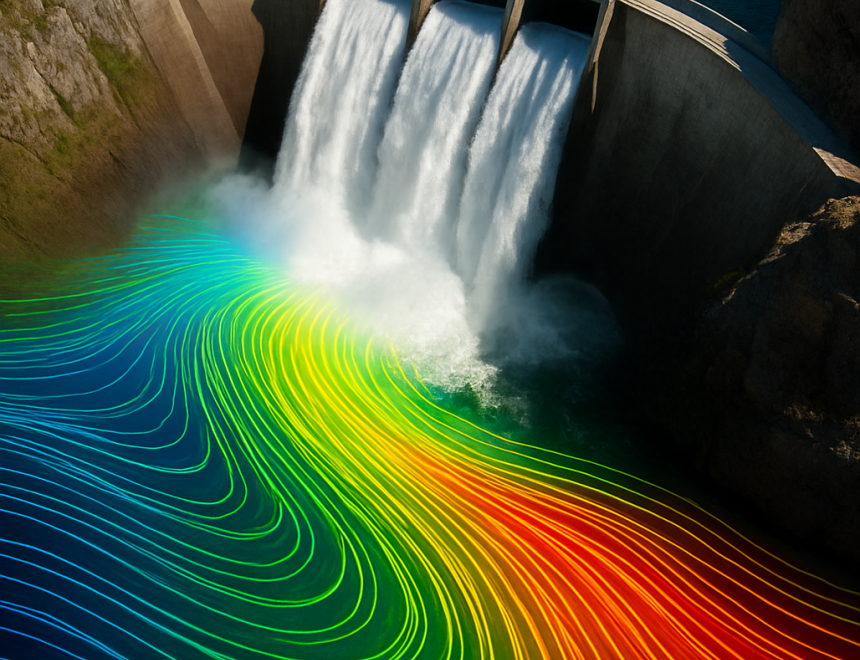
Area of expertise
When the complexity of hydraulic components prevents the use of charts or experimental testing, simulations provide an effective means of estimating the performance of these components. CFD codes enable the analysis and prediction of the behaviour of internal or free-surface flows, whether single-phase, multiphase or influenced by gravity.
The field of hydraulics mainly covers two types of flow:
- single-phase flows, particularly in pressurised circuits;
- and multiphase flows, often gravity-driven and involving a free surface.
Hydraulic circuits
CFD simulations make it possible to determine the operating points of the various components of a hydraulic circuit, such as pressure losses and flow distribution, across several configurations.
They offer multiple advantages:
- characterising the behaviour of a component alone or integrated into its circuit;
- assessing the pressure losses of a future component based on its geometry;
- developing a numerical model correlated with experimental data in order to simulate the consequences of a geometric modification;
- building a simplified 1D environment of a circuit that incorporates the behaviour of all its components, in order to test its response under different scenarios.
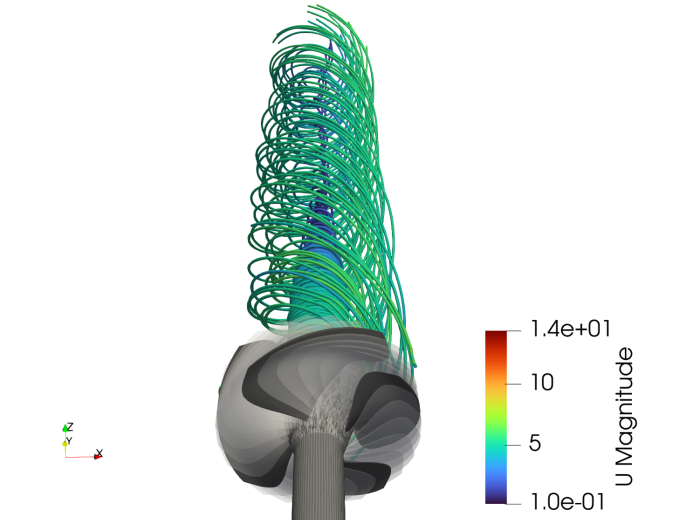
Free-surface flows
Free-surface flows are characterised by strong inertial behaviour and require models capable of simulating the behaviour of the interface between several fluids, most often liquid and gas.
Depending on the data required, we can use different calculation methods for this type of flow, such as Eulerian or Lagrangian methods.
Thanks to CFD simulations, we are able to:
- visualise hot or polluted discharges in different environments, such as lakes, canals or basins;
- and estimate the forces acting on structures subjected to waves or other hydrodynamic forces.
SPH methods are particularly well suited to simulations involving impact, breaking waves or fluid-structure interaction with moving physical boundaries.

Our references