Industrial processes
CFD calculation codes include several physical models that allow us to address a wide range of industrial issues. The data obtained from the simulations is then used to estimate the behaviour or performance of the systems studied.
Heat transfer
Thermal models incorporate the various aspects of heat exchange, namely conduction, convection and radiation. With the simulation data collected in this way, it is possible, for example, to:
- obtain the thermal loading throughout the volume of a part in order to calculate its mechanical stresses;
- identify potential evaporation zones within a cooling circuit;
- characterise changes in the performance of a heat exchanger according to the desired geometric modifications;
- estimate the heat released by chemical processes;
- or map the temperature field of electronic components in order to study the risk of overheating.
Collaboration with a specialised engineering consultancy is possible in order to couple the results obtained with a mechanical analysis, making it possible to determine the thermomechanical strength or fatigue resistance of a specific component.
Contact usSpecies transport
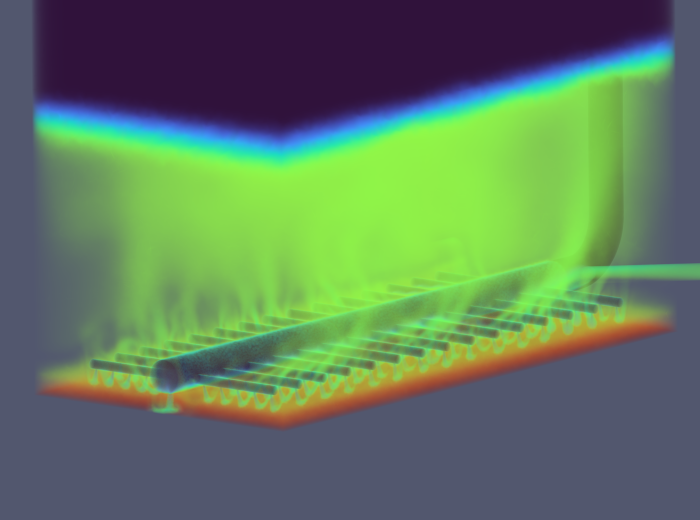
Species transport simulations, using miscible fluid models or particle tracking models, are useful for addressing a range of issues, such as:
- the removal of gaseous compounds or solid particles in cleanrooms or aquatic environments;
- the proper dilution of fluids in mixing tanks, discharge basins or fluidised beds;
- the deposition and accretion of sediment in wastewater treatment or exhaust gas treatment systems;
- the distribution of species in chemical reaction simulations.
These species transport models can be coupled with methods used to simulate the movement of mobile elements, such as mixer blades or pump impellers.
Discover our software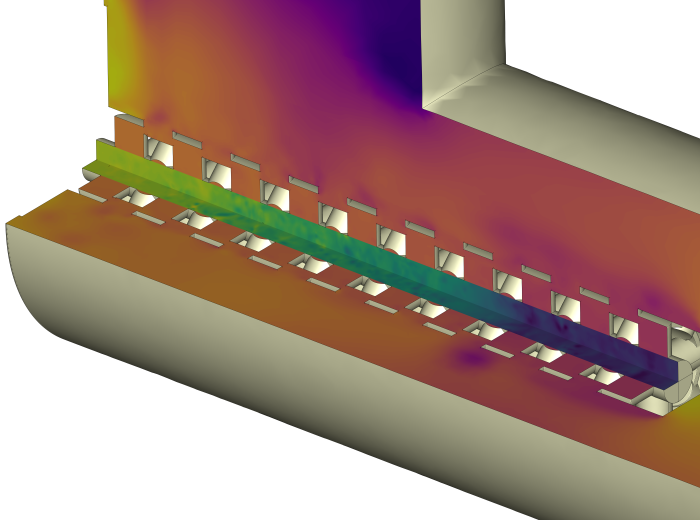
Our references